Lunation
This case study describes experience gained by team members across prior roles and engagements.
01/05 All projects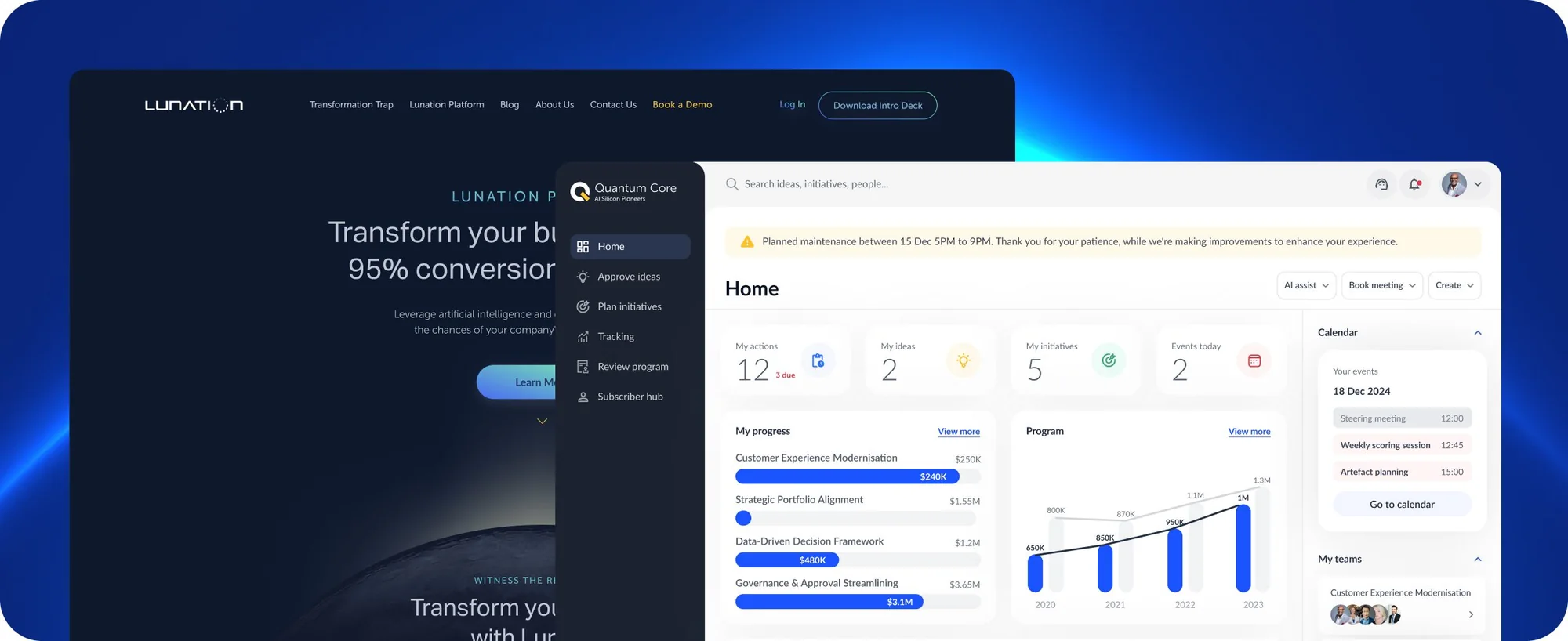
The project
Lunation is a web-based transformation platform designed to help organisations structure, prioritise, and execute complex change initiatives. The platform supports teams in shaping strategy, aligning stakeholders, and turning ideas into actionable programs through structured workflows and shared visibility.
The project focused on UX & UI design for a web application MVP, translating abstract transformation concepts into practical, usable experiences. The aim was to create clarity across decision-making, collaboration, and execution while ensuring the product could scale with organisational needs.
What we did
UX strategy, discovery facilitation, research, IA, interaction design, prototyping, testing, design system foundations
Impact
Clearer alignment
Structured workflows helped teams align around shared goals and priorities.
- Simplified execution
- Complex transformation initiatives were broken into manageable steps.
- Reduced friction
- Clear navigation and hierarchy lowered cognitive effort for users.
- Improved confidence
- Users gained better visibility into progress and decision rationale.
- Consistent feedback
- Clear status indicators supported informed next steps.
- Flexible structure
- Modular patterns supported different transformation scenarios.
- Improved clarity
- Plain language reduced ambiguity across complex initiatives.
- Scalable foundation
- The MVP was designed to support future feature growth.
In use
The product as it was shipped, captured as it renders.
Mission
The mission was to design a clear, accessible web application that helps organisations navigate transformation with confidence. The experience needed to balance strategic thinking with practical execution, without overwhelming users with unnecessary complexity.
Key challenges
- Abstract concepts
- Turning transformation strategy into actionable digital workflows.
- Multiple stakeholders
- Supporting different roles, priorities, and perspectives.
- Early-stage ambiguity
- Designing while the product direction was still forming.
- Information density
- Presenting complex data without overwhelming users.
- Adoption
- Creating an MVP that felt credible and usable from day one.
Objectives
- Validate the product vision through an MVP
- Create intuitive flows for transformation planning
- Support collaboration and shared understanding
- Lay foundations for scalability
- Ensure accessibility across user needs
Process
The work followed a structured, research-led design process typical of web app and MVP design, combining discovery, validation, and iteration.
-
01
Research & insights
The discovery phase included workshop facilitation, stakeholder interviews, proto-personas, Value Proposition Canvas exercises, user story mapping, user interviews, and card sorting to understand needs, mental models, and priorities.
-
02
Ideation & wireframes
Information architecture, user flow diagrams, and low-fidelity wireframes were used to structure the MVP before visual design.
-
03
Hi-fi designs & prototyping
High-fidelity designs and brand foundations were developed alongside interactive prototypes to validate usability and tone.
-
04
Testing
User testing sessions helped refine flows, interactions, and comprehension before further development investment.
-
05
Accessibility
Accessibility was considered throughout, with a focus on readability, contrast, keyboard navigation, and reducing cognitive load.
-
06
Design system
A component library ensured consistency, scalability, and accessibility across the evolving web application.
What we learned
Designing transformation software requires clarity first. Strong information architecture, accessible patterns, and early validation helped turn abstract strategy into a usable, scalable digital product.